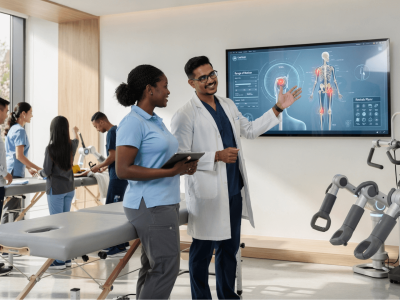
Smart Rehab is reshaping how physiotherapy exercises are prescribed, monitored, and progressed moving care from episodic handouts to continuous, data-supported rehabilitation pathways.
While clinically sound in principle, this approach was designed for an era of episodic care not for modern rehabilitation systems under pressure to deliver consistent outcomes at scale.
Digital technology is now transforming this model. What is emerging is not simply a set of tools, but a new form of digital prescription (Digital Rx) where assessment, exercise delivery, feedback, and monitoring are integrated into a continuous rehabilitation pathway.
The significance of this shift lies not in convenience, but in its impact on outcomes, engagement, and value.
Why Smart Rehab Replaces Traditional Exercise Prescription
Traditional home exercise programmes rely heavily on patient memory, motivation, and confidence. Once patients leave the clinic, clinicians have limited visibility into what actually happens.
Exercises may be performed incorrectly, inconsistently, or not at all often without the clinician knowing until progress stalls.
From a system perspective, this creates three problems:
- engagement is assumed rather than supported
- progress is difficult to measure between appointments
- outcomes become variable and unpredictable
These limitations are not a failure of patients or clinicians. They are a consequence of a prescription model that lacks continuity.
Digital Rx as a Continuity Model
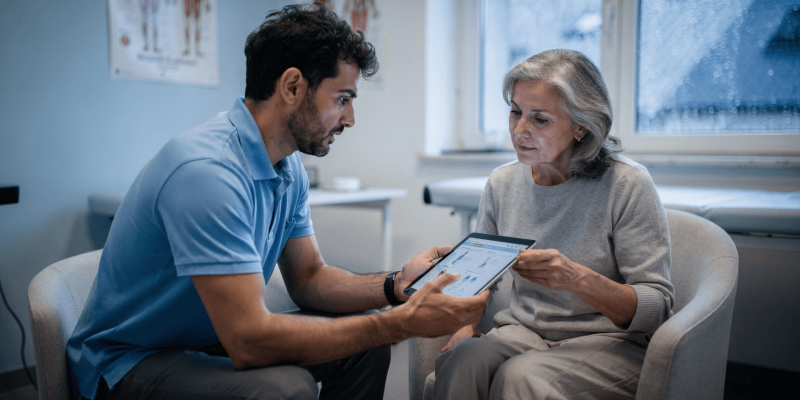
Digital prescription changes the nature of rehabilitation delivery. Instead of a static handover, exercises are delivered through digital platforms that provide clear guidance, visual demonstration, and structured progression.
Patients receive reminders, feedback, and reassurance outside the clinic, while clinicians gain insight into adherence and performance.
This transforms physiotherapy from an episodic intervention into a continuous care experience. For operators and payers, continuity is the foundation of scalable, outcomes-driven rehabilitation.
Engagement Is Designed, Not Requested
One of the most consistent findings across digital rehabilitation is improved engagement not because patients are more motivated, but because engagement is structurally supported.
Visual guidance reduces uncertainty. Progress dashboards make improvement visible. Timely prompts reduce reliance on memory. Real-time or near-real-time feedback supports motor learning and confidence.
In this model, adherence is no longer dependent on willpower alone. It becomes a by-product of design.
This matters because engagement directly influences recovery timelines, utilisation, and long-term outcomes all critical variables in value-based care models.
How Smart Rehab Improves Clinical Decision-Making
Digital Rx platforms generate data that traditional prescription models cannot. Wearable sensors, markerless motion capture, and usage analytics provide objective insight into movement quality, activity levels, and adherence patterns.
For clinicians, this supports more precise decision-making. For services, it enables:
- earlier identification of stalled progress
- targeted intervention for at-risk patients
- reduced reliance on subjective reporting
From a payer perspective, objective data strengthens attribution- clarifying whether outcomes reflect care quality, engagement, or external factors.
Smart Rehab Beyond the Clinic
Digital prescription also reshapes access. Tele-rehabilitation and remote monitoring allow supervised care to continue regardless of geography, mobility, or scheduling constraints.
This does not replace in-person physiotherapy. Instead, it rebalances it reserving face-to-face time for complex assessment, hands-on treatment, and clinical reasoning, while digital pathways support continuity between sessions.
At scale, this hybrid model improves access without linear increases in workforce or infrastructure.
Predictive Insight and Proactive Intervention
As digital prescription platforms mature, predictive analytics play an increasing role. Patterns in adherence, performance, and symptom reporting can flag patients at risk of disengagement, re-injury, or delayed recovery.
This enables proactive adjustment of programmes before outcomes deteriorate-a critical capability for value-based rehabilitation models that reward prevention over reaction.
Efficiency as an Outcomes Enabler
While efficiency gains are often framed as operational benefits, they have downstream effects on outcomes.
Automated documentation, scheduling, and reporting reduce administrative burden, freeing clinicians to focus on higher-value interactions.
For patients, this often translates into:
- more timely responses
- clearer communication
- better continuity of care
Efficiency, when aligned with clinical goals, becomes an outcomes enabler rather than a cost-cutting exercise.
Digital Rx and Value-Based Rehabilitation
The emergence of Digital Rx aligns closely with the shift toward outcomes- and value-based care. Continuous engagement, objective measurement, and early intervention are all prerequisites for linking reimbursement to results rather than volume.
Digital prescription does not guarantee better outcomes but without it, scalable value-based rehabilitation is difficult to achieve.
Rehbox and Digital Prescription at Scale
Rehbox is being developed around this Digital Rx model. Rather than treating technology as an add-on, the platform integrates assessment, prescription, feedback, monitoring, and reporting into a single digital rehabilitation pathway.
The goal is not to digitize paper exercises, but to enable continuous, measurable, and outcomes-driven rehabilitation that supports clinicians while meeting the expectations of modern healthcare systems.
Looking Ahead
Digital prescription represents a structural shift in how physiotherapy is delivered. As rehabilitation systems face rising demand and increasing accountability for outcomes, the ability to support patients continuously rather than episodically will define success.
In that sense, Digital Rx is not a technological trend. It is an evolution in care delivery one that aligns rehabilitation with the realities of modern healthcare.