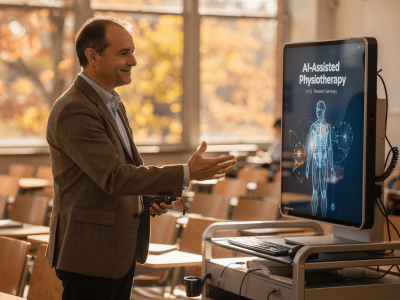
Clinical AI adoption is accelerating across healthcare delivery. It is already embedded across triage, assessment, digital rehabilitation, outcomes measurement, and clinical decision support. As these systems scale, a new challenge is becoming increasingly visible workforce readiness.
For physiotherapy, the question is no longer whether AI will be part of practice, but whether the workforce is adequately prepared to work alongside it safely, critically, and effectively. This is not simply an education issue. It is a system risk.
When clinicians lack foundational AI literacy, the consequences extend beyond individual practice. They affect governance, safety, outcomes, and the ability of healthcare organisations to deploy digital rehabilitation at scale with confidence.
Clinical AI Adoption Introduces New Workforce Risks
Much of the current discussion around AI in physiotherapy focuses on tools: digital triage, motion capture, remote monitoring, predictive analytics. Far less attention is paid to the human layer required to make these systems work reliably.
AI-enabled care introduces new responsibilities for clinicians:
- interpreting AI-generated insights
- understanding limitations and bias
- knowing when to challenge or override recommendations
- explaining AI-supported decisions to patients
Without a workforce that understands these fundamentals, AI becomes harder to govern and riskier to scale. Systems may be technically sound but operationally fragile.
This is where workforce readiness becomes a prerequisite for safe digital transformation.
A Growing Gap Between Practice and Preparation
Physiotherapy has already embraced digital delivery in areas such as tele-rehabilitation, wearable monitoring, and remote exercise prescription. Yet formal preparation for AI-augmented practice remains limited.
Comparative literature searches illustrate this gap clearly. While thousands of publications now explore AI in medical and dental education, only a handful directly address AI within physiotherapy training.
This disparity is not merely academic. It reflects how differently professions are preparing their future workforce for AI-enabled care.
As digital rehabilitation platforms become more common, this gap creates downstream consequences:
- inconsistent use of AI-supported tools
- over-reliance on automation in some settings
- under-utilisation or mistrust in others
- difficulty establishing clear accountability when outcomes vary
For healthcare operators and insurers, this variability undermines predictability- a key requirement for value-based and outcomes-linked models of care.
Why Clinical AI Adoption Requires AI Literacy
AI literacy does not mean turning physiotherapists into data scientists. It means ensuring they have sufficient understanding to:
- interpret AI outputs appropriately
- recognise when data quality is poor
- understand where algorithms support reasoning and where they do not
- maintain clinical authority in AI-supported pathways
In practice, AI literacy becomes part of clinical governance. Just as clinicians are expected to understand imaging limitations or outcome measure validity, they must also understand the strengths and constraints of AI systems influencing care.
Without this baseline, organisations face increased risk:
- inappropriate escalation or de-escalation of care
- automation bias
- erosion of patient trust
- difficulty defending AI-supported decisions under scrutiny
Education as Infrastructure, Not Curriculum Content
Traditionally, education has been treated as an upstream activity, something that happens before practice begins. AI changes this assumption.
Because AI systems evolve, learning cannot be confined to pre-registration training alone. Workforce readiness must be continuous, supported through:
- structured AI literacy frameworks
- ongoing professional development
- clear organisational guidance on AI use
- integration of AI understanding into supervision and audit
In this context, education becomes part of delivery infrastructure, not a one-off intervention. Systems that fail to invest here may find themselves constrained — unable to scale digital rehabilitation safely despite having the technology in place.
The Risk of Falling Behind Other Disciplines
Other healthcare professions are moving more rapidly to address AI readiness. Medical and dental education programmes increasingly include AI literacy, data interpretation, and digital ethics as core competencies.
If physiotherapy lags behind, the risk is not only professional relevance, but influence. Professions that understand AI shape how it is deployed. Those who do not are shaped by it.
For physiotherapy, a profession grounded in human movement, rehabilitation, and long-term outcomes, this would represent a significant missed opportunity.
What Workforce-Ready AI Integration Could Look Like
From a system perspective, AI-ready physiotherapy workforces would be characterised by:
- confidence in working with AI-supported tools
- critical engagement rather than blind trust
- consistent application of digital pathways
- clear escalation and override practices
- ability to explain AI-supported decisions to patients
This readiness supports safer scaling, clearer governance, and more reliable outcomes all priorities for healthcare operators and insurers.
Rehbox and Workforce-Ready Digital Rehabilitation
Rehbox is being developed with this workforce reality in mind. Digital rehabilitation platforms do not succeed purely through technical performance; they succeed when clinicians understand how to work with them.
By embedding transparency, clinician control, and interpretable insights into the rehabilitation workflow, Rehbox aims to support AI-enabled care without displacing professional judgement.
The focus is not on replacing expertise, but on ensuring the workforce remains confident, informed, and in control as digital delivery scales.
Looking Ahead
As AI becomes increasingly embedded in physiotherapy delivery, workforce readiness will determine whether digital rehabilitation improves outcomes or introduces new risks.
Education, in this sense, is not about future graduates alone. It is about ensuring today’s workforce can safely adopt, govern, and evolve alongside AI-enabled systems.
For healthcare organisations, insurers, and professional bodies, the message is clear:
AI literacy is no longer optional. It is foundational infrastructure for modern rehabilitation delivery.
Those who invest early will shape the future of care. Those who delay may find themselves constrained — not by technology, but by readiness.