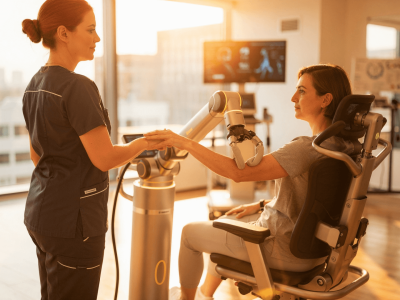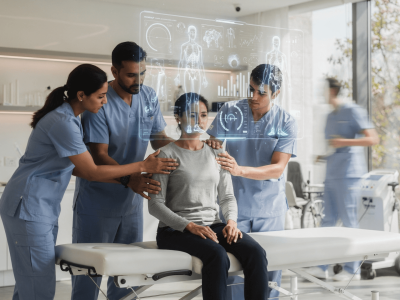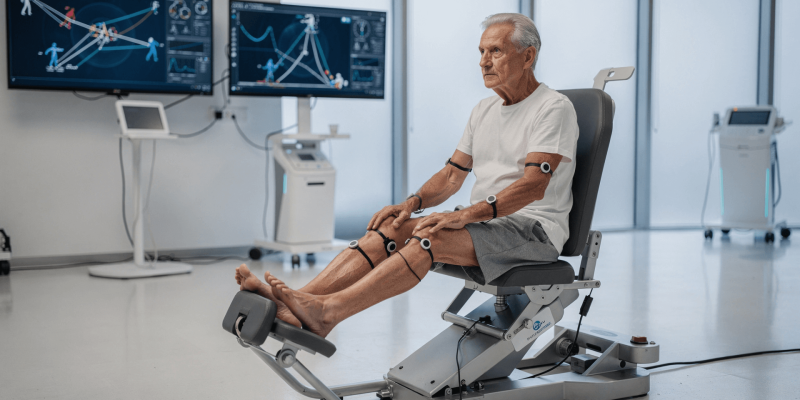
AI motion analysis is transforming how human movement is assessed—bringing objectivity, scalability, and precision to modern physiotherapy and rehabilitation systems.For physiotherapy and rehabilitation services, accurately assessing that movement has always been central to effective care. Yet traditional observation-based assessment, while clinically valuable, is inherently subjective and difficult to standardise at scale.
The convergence of artificial intelligence (AI) and motion capture technology is beginning to change this dynamic.
Together, they are enabling a shift from episodic, subjective assessment toward continuous, objective, and measurable insight with significant implications for outcomes, consistency, and scalability in modern rehabilitation systems.
AI Motion Analysis: From Observation to Measurement at Scale
Historically, motion capture was confined to specialist laboratories using marker-based systems and multiple cameras. While accurate, these setups were expensive, time-consuming, and impractical for routine clinical use.
Recent advances in AI-powered, markerless motion capture have removed many of these barriers.
Computer vision models can now extract joint positions, kinematics, and movement patterns from standard video captured on consumer devices.
Wearable inertial sensors further extend this capability into real-world environments, capturing acceleration, rotation, and load outside the clinic.
AI acts as the analytical layer that transforms raw movement data into clinically meaningful signals — identifying asymmetries, deviations, and patterns that may not be visible to the human eye.
From a system perspective, this represents a critical shift: movement assessment becomes measurable, repeatable, and comparable across patients and settings.
Why Objectivity Matters for Outcomes
Traditional movement assessment relies heavily on clinician experience and interpretation. While expertise remains essential, variability between observers is unavoidable, particularly under time pressure or high caseloads.
AI-enhanced motion capture introduces objective metrics — joint angles, velocities, symmetry indices, variability measures — that can be tracked consistently over time.
Research has demonstrated that modern markerless systems can achieve accuracy comparable to lab-based gold standards, with reported joint angle estimation accuracy exceeding 90% in controlled studies (Cutti et al., 2018; Pfister et al., 2020).
For rehabilitation systems, objectivity matters because:
- early deviations can be detected sooner
- progression decisions can be standardised
- outcomes can be compared across cohorts
- clinical reasoning is supported by evidence rather than memory
- This does not replace expertise — it anchors it.
Early Detection and Risk Stratification
One of the most powerful applications of AI-driven motion analysis is early detection of dysfunction. Algorithms trained on large datasets can identify subtle changes in variability, symmetry, or coordination long before they become clinically obvious.
Evidence suggests that AI-based gait analysis improves sensitivity for detecting early Parkinsonian changes compared with visual assessment alone (Espay et al., 2021).
In older populations, similar approaches support earlier identification of fall risk. In sports and MSK populations, inefficient loading patterns can be flagged before they result in injury.
At scale, this capability supports risk stratification rather than reactive care — a foundational requirement for outcomes-driven and value-based rehabilitation models.
Measuring Progress, Not Guessing It
Progress tracking has traditionally relied on intermittent reassessment and patient self-report. These methods are valuable but limited in resolution.
AI-enabled motion capture allows incremental change to be measured objectively. Improvements in step length, squat depth, symmetry, or coordination can be quantified session by session.
For patients, this makes progress visible. For clinicians and payers, it provides defensible evidence of change.
Research indicates that patients receiving motion capture–based feedback demonstrate higher adherence to home programmes compared with standard instruction alone (Disability and Rehabilitation, 2022).
This highlights an important secondary benefit: measurement itself becomes a driver of engagement.
Extending Assessment Beyond the Clinic
Perhaps the most transformative implication of AI-driven motion capture is portability. Markerless systems running on consumer devices allow functional assessments to take place outside traditional clinical environments.
Remote assessment supports:
- rural and mobility-limited populations
- hybrid care models
- reduced non-attendance
- continuity between appointments
Evidence from stroke rehabilitation demonstrates that AI-supported remote gait monitoring can produce outcomes comparable to in-person assessment, while reducing travel burden and missed appointments (Laver et al., 2021).
From an operator perspective, this enables scale without proportional increases in physical infrastructure.
Personalised Treatment and Real-Time Feedback
The value of motion capture does not end at assessment. When integrated into treatment delivery, AI-driven analysis informs more precise intervention.
Specific deficits such as delayed muscle activation, valgus collapse, or asymmetrical loading — can be targeted directly.
Real-time biofeedback supports motor learning by correcting technique during execution rather than after the fact, which has been shown to accelerate skill acquisition (Wulf & Lewthwaite, 2020).
This capability transforms rehabilitation from retrospective correction to guided performance, improving both effectiveness and confidence.
Engagement, Gamification, and Sustainability
Sustained engagement remains a limiting factor in long-term rehabilitation. Motion capture combined with gamified or virtual environments introduces an additional lever for retention.
Embedding exercises within interactive tasks or challenges increases enjoyment and adherence, particularly in neurological and long-duration rehabilitation programmes (Matamala-Gomez et al., 2020).
While gamification alone is not a solution, when combined with objective feedback it supports continuity and motivation.
For systems under pressure, engagement is not a luxury it is a determinant of outcomes.
AI Motion Analysis for Injury Prevention and Load Management
Beyond rehabilitation, AI-driven motion capture supports preventative care. Analysis of running mechanics, jump landings, and repetitive loading can identify patterns associated with overuse and non-contact injury.
Research in sports medicine highlights the role of wearable sensors and AI in predicting ACL injury risk and informing proactive intervention strategies (van Hooren et al., 2021).
For operators, this supports a shift from treatment to prevention reducing downstream cost and disruption.
A Balanced Perspective: Precision Without Replacement
Despite its promise, AI-driven motion capture is not a substitute for clinical judgement. Data requires interpretation, context, and translation into meaningful care.
Psychosocial factors, motivation, pain perception, and therapeutic alliance remain outside the reach of algorithms.
AI and motion capture should therefore be understood as precision amplifiers, not decision-makers. Their value lies in supporting consistency, objectivity, and scalability while clinicians remain accountable for care decisions.
Rehbox and Precision at Scale
Rehbox is being developed with this system-level understanding of precision. By integrating AI-driven motion analysis into a broader digital rehabilitation framework, the platform supports objective assessment, progress tracking, and personalised feedback without fragmenting clinical workflows.
The focus is not on replacing observation, but on making high-quality assessment scalable, measurable, and defensible across populations.
Looking Ahead
The integration of AI and motion capture marks a meaningful shift in rehabilitation delivery.
As services move toward outcomes-based and value-driven models, objective measurement will become increasingly central to assessment, progression, and accountability.
The organisations that succeed will not be those with the most advanced sensors, but those that integrate precision tools thoughtfully aligning them with governance, clinician oversight, and patient-centred care.
In that sense, AI-enabled motion capture is not just a technical advance. It is a structural enabler of modern rehabilitation systems.