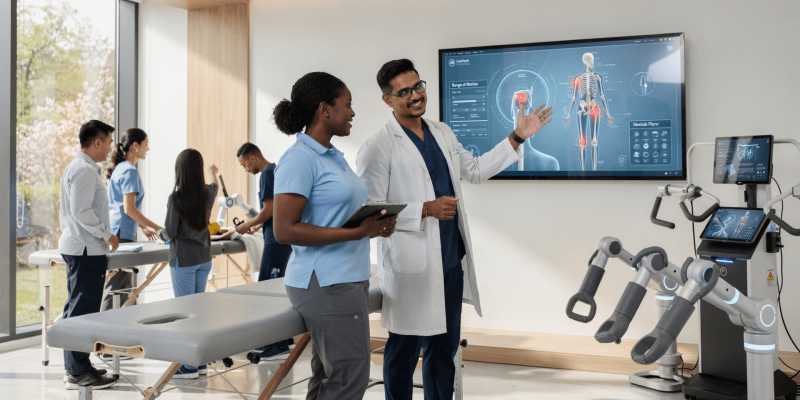
Digital rehabilitation systems powered by artificial intelligence are no longer entering physiotherapy quietly. Across healthcare systems, they are reshaping how patients access care, how clinicians prioritise demand, and how rehabilitation services operate under sustained pressure.
While early adoption of digital rehabilitation systems has focused on frontline efficiency triage, diagnostics, and administrative relief, the deeper significance lies in how AI is beginning to reconfigure rehabilitation delivery at a system level.
For health systems facing rising musculoskeletal (MSK) demand, workforce constraints, and widening access gaps, digital rehabilitation systems are emerging not as a replacement for physiotherapists but as a way to extend clinical capacity without proportionally increasing cost or staffing.
From Bottlenecks to Digital Front Doors in Digital Rehabilitation Systems
Assessment and triage have long been pressure points in physiotherapy pathways. Traditional models rely heavily on clinician availability and manual interpretation, often leading to inconsistent prioritisation and long delays before treatment begins. AI-enabled triage has started to change this dynamic.
By analysing structured patient-reported data against clinical algorithms, AI systems can support earlier routing decisions, identify red flags, and ensure patients enter the most appropriate pathway sooner.
In large health systems, this has translated into shorter waiting times, reduced inappropriate escalation, and improved safety at the point of first contact.
The significance here is not speed alone. For operators and insurers, AI-supported triage introduces consistency.
Pathway entry becomes less dependent on local capacity or individual judgement and more aligned with standardised clinical logic. This creates the conditions for fairer access, clearer audit trails, and more predictable downstream utilisation.
Importantly, this approach is no longer confined to MSK care. Similar models are now being applied across neurological, pulmonary, pelvic health, and community rehabilitation pathways, signalling a broader shift toward digital “front doors” for rehabilitation services.
Diagnostics, Imaging, and the Rise of Objective Insight
Physiotherapy has traditionally relied on observation, manual testing, and clinician reasoning, often supplemented by imaging when available.
Access to advanced diagnostics, however, remains uneven across regions and services.
AI is narrowing this gap. Computer vision and imaging analytics now allow movement analysis and musculoskeletal assessment to be conducted remotely with increasing precision.
Smartphone-based motion capture and AI-assisted imaging interpretation are delivering levels of objectivity that were previously restricted to specialist environments.
At a system level, this matters because objective data reduces variability. It strengthens diagnostic confidence, supports more accurate progression decisions, and improves communication across multidisciplinary teams.
For insurers and operators, it also enhances defensibility, enabling clearer justification of care decisions and outcomes.
Yet this is also where caution is required. Diagnostic AI is powerful, but only when integrated within robust governance frameworks.
Regulatory oversight, transparency, and clinical accountability remain essential to ensure that enhanced precision does not come at the expense of trust or safety.
AI and the Acceleration of Rehabilitation Knowledge
Another less visible, but highly consequential, impact of AI in physiotherapy lies in research and evidence translation. The volume of rehabilitation research continues to grow, yet clinicians and services struggle to stay current.
AI-enabled research tools are now accelerating systematic reviews, identifying emerging patterns, and supporting predictive modelling at speeds previously unattainable.
This has the potential to shorten the gap between evidence generation and clinical practice, allowing rehabilitation pathways to evolve more dynamically in response to new knowledge.
For healthcare organisations, this capability supports faster learning systems. Rehabilitation services can adapt based on aggregated outcomes rather than relying solely on delayed guideline updates.
However, this benefit depends on careful validation. Speed without methodological rigour risks amplifying bias rather than improving care.
Administrative Relief as Strategic Capacity Gain
Administrative burden remains one of the most consistent drivers of clinician burnout and service inefficiency in physiotherapy.
AI-driven documentation and workflow automation have already demonstrated tangible benefits by reducing time spent on transcription, reporting, and compliance tasks.
While often framed as a productivity or wellbeing gain, the strategic implication is greater.
Reduced administrative load translates directly into increased clinical capacity, improved workforce sustainability, and more reliable data capture. At scale, these gains can materially influence service resilience and cost control.
For health system leaders, this is one of the clearest examples of AI delivering immediate return on investment provided implementation is aligned with existing systems and does not introduce parallel workflows.
Where the Limitations Still Matter
Despite these advances, AI in physiotherapy is far from a solved problem.
Many deployments remain fragmented, addressing isolated challenges without integrating across the rehabilitation journey. Data quality remains uneven, and algorithms trained on narrow populations risk poor generalisability.
There is also a persistent temptation to treat AI outputs as conclusions rather than inputs, undermining the very clinical reasoning they are meant to support.
Governance, too, is still maturing. Clear accountability structures, escalation pathways, and ethical oversight are essential if AI is to scale safely.
The World Health Organization has repeatedly emphasised that healthcare AI must operate under human supervision, with transparency and responsibility clearly defined.
From Frontline Tools to System Capability
The most important shift now underway is not technological, but conceptual. AI in physiotherapy is moving beyond frontline efficiency toward system capability.
When assessment, triage, monitoring, and reporting are connected within a single digital framework, rehabilitation becomes measurable and optimisable at the population level.
Variability decreases, outcomes become more transparent, and services can adapt proactively rather than reactively.
This shift also reshapes the role of physiotherapists. Rather than diminishing clinical expertise, AI enables it to be applied where it adds the most value complex cases, human engagement, and nuanced decision-making.
The profession becomes more specialised, supported by digital intelligence rather than constrained by manual workload.
Rehbox and the Infrastructure Mindset
Rehbox is being developed within this context not as a point solution, but as part of the emerging infrastructure required for modern rehabilitation delivery.
By supporting assessment, intelligent prescription, remote monitoring, and system-level insight within a single platform, Rehbox aims to help healthcare operators and insurers move toward consistent, outcomes-driven rehabilitation at scale.
The focus is on enabling governance, scalability, and clinical integrity rather than replacing human judgement.
Looking Ahead
AI has already begun to transform physiotherapy, but its most significant impact lies ahead. The organisations that succeed will be those that move beyond experimentation and treat digital rehabilitation as foundational infrastructure.
The question for healthcare leaders is no longer whether AI belongs in physiotherapy, but whether it will be implemented in a way that strengthens systems, supports clinicians, and delivers sustainable impact across populations.
The transition is underway. The strategic choice is how deliberately it is shaped
AI in Physiotherapy: Scaling Access, Equity, and Impact Across Health Systems
In Part 2, we will move beyond frontline applications to examine how AI enables scalable, equitable, and outcomes-driven rehabilitation at system level.
The focus will shift to:
- workflow orchestration across services
- intelligent treatment personalisation at scale
- predictive analytics for early intervention and risk management
- population-level rehabilitation models that balance access, quality, and cost
We will also explore how these capabilities align with national and international digital health strategies, including the NHS App Strategy and A Plan for Digital Health and Social Care, while ensuring their transferability to wider healthcare systems and insurer-led rehabilitation pathways.